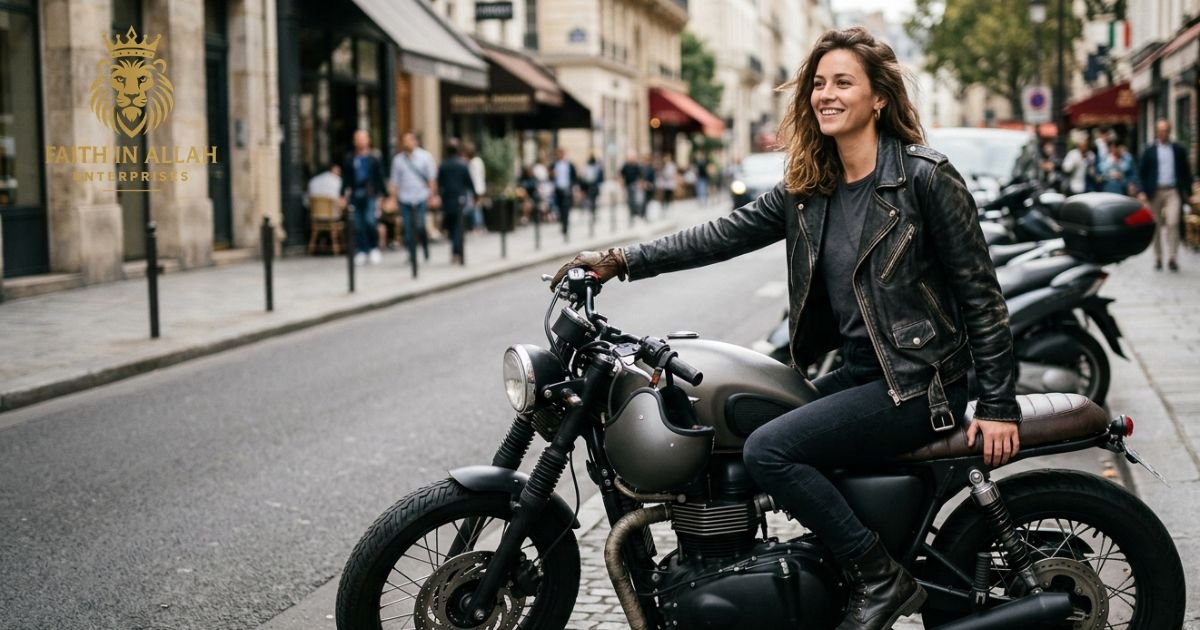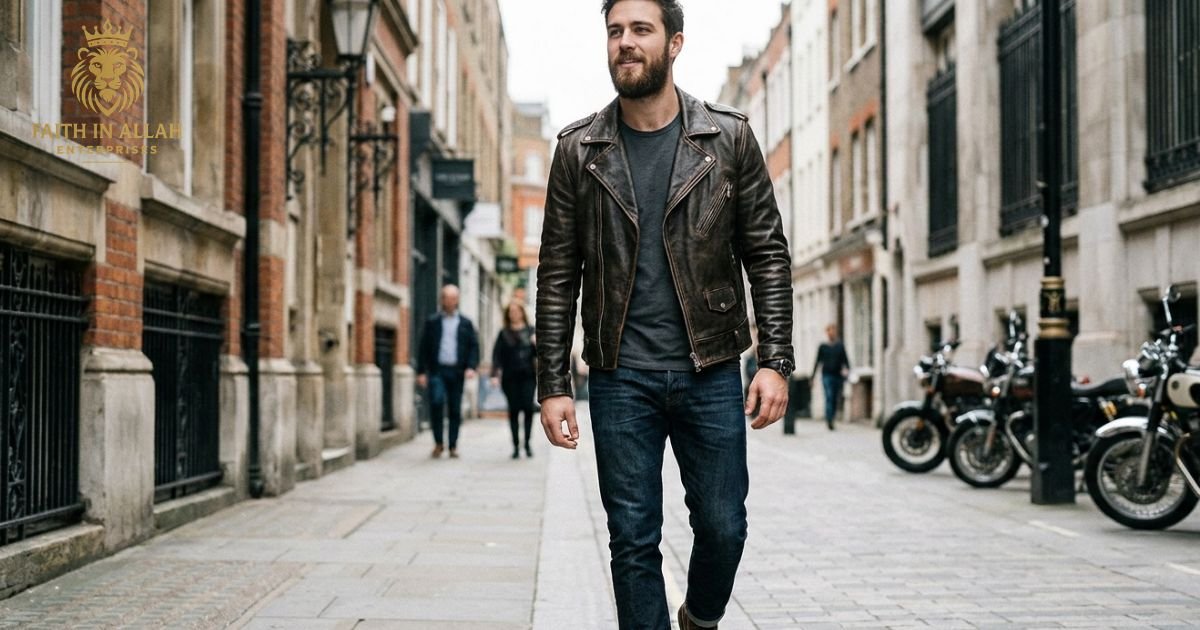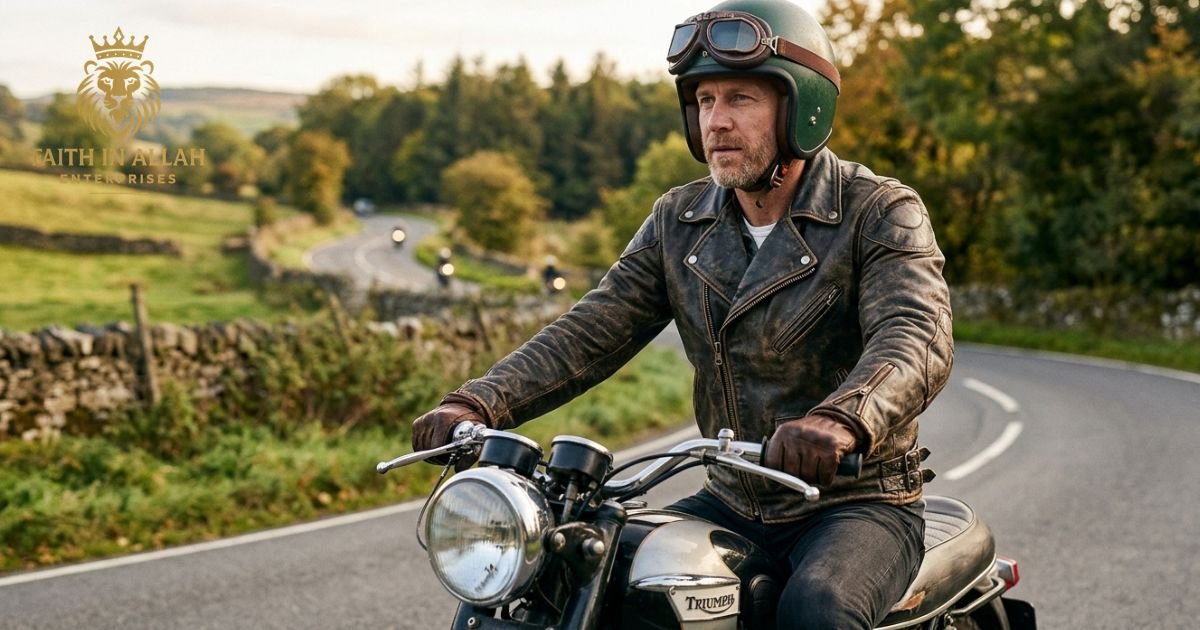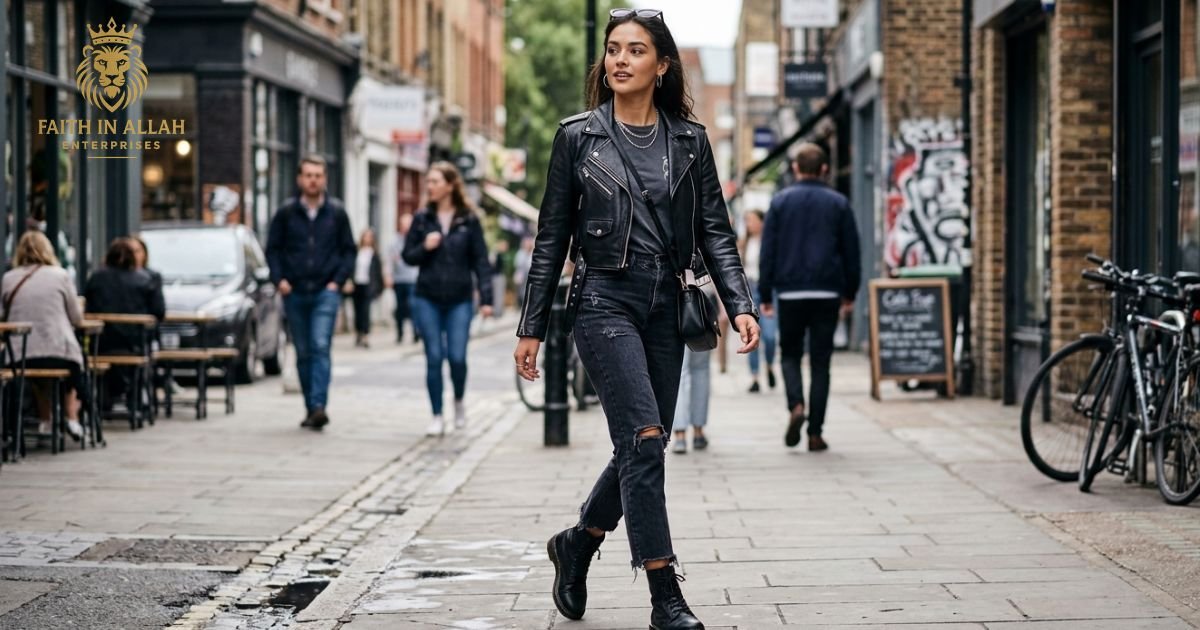
The biker leather jacket vintage is a timeless fashion piece that combines rugged style with classic appeal. Known for its durable leather, edgy design, and retro look, it remains a favorite choice for riders and fashion lovers alike. Whether paired with jeans or layered over casual outfits, it adds a bold and stylish statement to any wardrobe.
Key Takeaways What You Need to Know Before You Buy
Before we go deep, here’s the short version:
- True vintage means 20+ years old with period-correct construction — not just “distressed” styling
- Horsehide leather is the gold standard for vintage jackets; full-grain cowhide is an excellent second choice
- Price range: expect $300–$700 for good condition, $700–$1,500 for excellent, and $1,500+ for collector-grade pieces
- Top brands to know: Schott NYC, Vanson Leathers, Lewis Leathers, Buco, Belstaff, Cockpit USA
- Where to buy: Grailed, eBay, Etsy, and specialist vintage stores in NYC and LA
- Authenticity markers: Talon or Crown zippers, 8+ stitches per inch, brass hardware, period-correct lining
What Makes a Leather Jacket Truly “Vintage”? (Not Just Old)
This is the question nobody answers clearly and it’s the first thing you need to get right.
“Vintage” doesn’t just mean old. It doesn’t mean worn-out, distressed, or intentionally aged. A jacket sprayed with bleach and sold on a fast-fashion site is not vintage. A genuine vintage biker leather jacket is one that was made in a specific era, using the materials and construction methods of that time, and has aged naturally as a result of actual use.
The fashion industry generally defines vintage as 20 years or older. For biker jackets specifically, most collectors and experts point to three golden eras:
- 1940s–1960s: The original golden age. Horsehide leather, Talon zippers, military-influenced construction. These are the holy grails.
- 1970s–1980s: The punk and rock era. Heavier cowhide, more decorative hardware, slightly looser silhouettes.
- 1990s: The grunge revival period. Thinner leathers, slimmer fits, more varied color options.
Anything made after 2005 that’s been artificially distressed is not vintage, it’s vintage-inspired. There’s nothing wrong with that, but you should know the difference before you spend serious money.
The 5 Design Features That Define Every True Vintage Biker Jacket
Look for these five physical details. They’re the fingerprints of authentic construction:
- Asymmetric front zipper the defining visual signature. Runs diagonally across the chest rather than straight down the center. Original designs used Talon, Crown, or Conmar zippers, not modern YKK.
- Snap-down epaulets small shoulder straps that buckle down. Purely decorative on modern versions; on originals, they were functional.
- D-pocket a small zippered pocket on the left chest, shaped like the letter D. Used in original designs for a pocket watch or coins.
- Belted waist a half-belt or full adjustable waist strap at the back, allowing the jacket to cinch tight for riding.
- Quilted lining period-correct vintage jackets were lined with a diamond or square quilted satin lining, not a simple polyester liner.
If a jacket calling itself “vintage” is missing three or more of these, be skeptical.
Horsehide vs. Cowhide Which Leather Actually Makes a Better Biker Jacket?
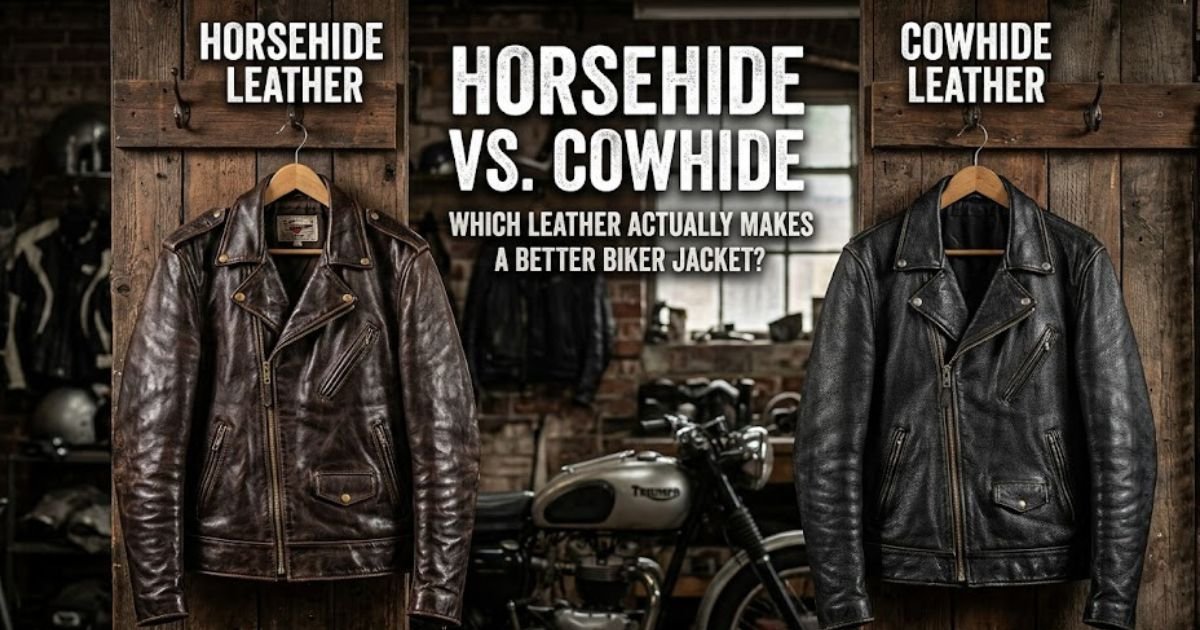
This is the question every serious buyer eventually lands on and it’s one that none of your competitors answer clearly. So let’s settle it.
Both are excellent. But they are not the same, and understanding the difference will change how you shop.
| Feature | Horsehide | Full-Grain Cowhide |
| Weight | Lighter for its thickness | Heavier |
| Durability | Exceptional denser fiber structure | Very good |
| Patina development | Develops richer, faster | Develops slower, more evenly |
| Break-in period | Longer, stiffer initially | Medium softens within weeks |
| Availability | Scarce limited production post-1965 | Widely available |
| Price premium | Significant 40–80% higher for equivalent piece | Standard market rate |
| Best for | Collectors, long-term investment | Everyday wearers, first-time buyers |
Horsehide was the material of choice for American biker jackets through the late 1950s Schott’s earliest Perfectos were horsehide. After horse leather production declined in the US from the 1960s onward, cowhide became the standard.
Today, a genuine vintage horsehide motorcycle jacket from the 1940s or 50s is a legitimate collector’s piece. Even in rough condition, these can sell for $1,000 or more.
Why Vintage Collectors Pay a Premium for Horsehide
Here’s what most guides won’t tell you: horsehide doesn’t just last longer it ages more beautifully.
The fiber structure of horse leather is tighter and denser than cowhide. That means it resists abrasion better, holds its shape under stress, and critically develops a deep, rich patina over decades of wear that cowhide simply cannot replicate.
The patina on a 1950s horsehide Schott looks like polished mahogany. It has depth and warmth that you can’t fake, can’t manufacture, and can’t rush. That’s why collectors pay what they pay.
If you’re buying your first vintage jacket for everyday wear, full-grain cowhide is the smarter choice, more available, easier to find in good condition, and still a genuinely great material. But if you’re building a collection or buying something you intend to pass down, horsehide is the standard to aim for.
How to Tell If a Vintage Leather Jacket Is Authentic (Not a Reproduction)
This is the most important skill you can develop as a buyer and the one nobody teaches properly.
The vintage leather market has two major problems: honest reproductions (quality brands making period-correct replicas, clearly labeled) and dishonest reproductions (sellers passing off modern fakes as genuine vintage). You need to tell all three apart quickly.
Here’s a step-by-step inspection process that takes less than five minutes:
Step 1: Check the zipper first. Look at the zipper pull and the zipper tape. Vintage jackets used Talon, Crown, or Conmar zippers, all American-made. Talon zippers have a distinctive box logo stamped on the pull. If you see “YKK” on the zipper of a jacket being sold as a pre-1980s vintage, stop there. YKK didn’t become the dominant zipper brand in the US until the late 1970s–80s, and even then, most quality biker jackets used Talon until well into the 1980s.
Step 2: Feel the leather grain. Run your palm flat across the back panel. Genuine full-grain leather has irregular surface variation, subtle variations in texture, tiny natural marks, slight differences in color tone. Corrected-grain or bonded leather (common in fakes) feels unnervingly uniform and slightly plastic. It’s too perfect. Real leather has character.
Step 3: Count the stitches. Bring a ruler. On a genuine vintage biker jacket, you should see 8 to 12 stitches per inch on the main seams. Cheap modern reproductions often use 4–6 stitches per inch faster to produce, but the seams pull apart under stress. This is the easiest objective quality test you can do without any special knowledge.
Step 4: Check the hardware. All original metal hardware on a quality vintage jacket buckles, D-rings, snap buttons, zipper pulls should be brass or solid zinc alloy. It will feel heavy and have weight to it. Pot metal (a cheap alloy) feels lighter and often shows chrome plating that chips at the edges. Look at the back of buckles: cheap hardware has visible mold seams and rough edges.
Step 5: Examine the lining. The interior tells you a lot. Pre-1970s jackets typically have satin or quilted rayon linings, often in bright colors orange, red, or gold. Post-1980s reproductions tend to use plain black polyester. More importantly, look at how the lining is attached. In genuine vintage jackets, the lining is hand-stitched or carefully machine-stitched at every seam. In fakes, it’s often glued or crudely tacked.
Step 6: Smell it. This sounds strange, but it works. Genuine aged leather has a distinctive earthy, slightly smoky, organic smell complex and not entirely pleasant, but unmistakably real. Modern bonded leather or synthetic fakes have a sharper, more chemical smell. Artificial aging sprays smell like silicone or solvent. Your nose knows.
Step 7: Ask about the label. Legitimate vintage biker jackets from established brands will have a maker’s label inside often at the collar or on the interior pocket. Look up the brand and date range for that label style. Many brands changed their label design every decade, and collectors have documented these changes in detail. A Schott label from the 1950s looks completely different from one made in the 1980s.
Expert Insight: What I Check in the First 60 Seconds
When evaluating a vintage jacket in person at a market, a consignment shop, or a private sale here’s exactly how the first minute goes.
The zipper pull gets touched before anything else. The weight and texture of the pull tells you almost immediately whether you’re dealing with quality brass hardware or cheap pot metal. Then I fold the jacket forward from the back collar and look at the inside of the seam where the collar meets the back panel. This is the most stressed point on any biker jacket, and cheap construction shows up there first as loose threads, cracking lining, or uneven stitching.
After that, I hold the jacket up to light at an angle and look at the surface grain across the shoulders and back. Light reveals everything. Genuine leather has an alive, irregular quality even after decades. Fakes look flat.
The 6 Best Vintage Biker Leather Jacket Brands and What Sets Each Apart
Not all heritage brands are equal. Here’s who actually matters and why.
1. Schott NYC (est. 1913) The originator. Schott created the Perfecto 618 in 1928, the jacket that defined the entire category. Irving Schott named it after his favorite cigar. Marlon Brando wore it in The Wild One. Everything that came after is either inspired by or reacting to the Perfecto. Still made in New Jersey today, original vintage Perfectos from the 1950s–60s are the most collectible American leather jackets in existence.
2. Vanson Leathers (est. 1974) Based in Fall River, Massachusetts, Vanson makes what many riders consider the finest handmade leather motorcycle jackets in America. Their traditional 50s and 60s-style models are not truly vintage, but they are made with the same construction methods and materials as the originals. If you want a new jacket with genuine vintage DNA, Vanson is where you go.
3. Buco (1930s–1960s) Buco is a collector’s brand. Made by Joseph Buegeleisen Co. of New York, Buco jackets from the 1940s and 50s horsehide, heavily lined, with distinctive hardware represent the apex of American vintage biker style. Finding a genuine Buco in wearable condition today means paying serious money, typically $800–$2,500 depending on condition and model.
4. Lewis Leathers (est. 1892) The British counterpart to Schott. Lewis Leathers supplied the 1960s Rockers scene and remains the defining name in British motorcycle leather. Their Cyclone and Lightning models are still in production. Vintage Lewis from the 1960s–70s are highly sought after and command strong prices on both sides of the Atlantic.
5. Belstaff (est. 1924) Originally a waxed cotton brand that moved into leather in the 1970s, Belstaff became iconic through its association with motorcycle adventurers and celebrities including Steve McQueen. Vintage Belstaff jackets, particularly waxed cotton Trialmaster models are beloved by collectors who want to function alongside history.
6. Cockpit USA (est. 1991) A relative newcomer in vintage terms, but Cockpit USA has built a strong reputation for American-made heritage leather jackets with genuine construction quality. Their motorcycle collection draws on the same aesthetic as the 1950s originals. Good entry point for buyers who want craftsmanship without the collector-grade price tag.
Schott Perfecto 618: The Jacket That Started It All
In 1928, Irving Schott designed the Perfecto named for the cigar and sold it through Harley-Davidson dealers for $5.50. At the time, it was a functional motorcycle jacket. By 1953, Marlon Brando had turned it into a symbol of rebellion that has never fully gone away.
The 618 is distinguished by its left-hand asymmetric zip, wide lapels, snap-down epaulets, dual chest pockets, and half-belt at the back. The original 1950s versions were made in horsehide. Later versions shifted to cowhide. Both are exceptional.
A clean original 1950s Perfecto 618 in horsehide today sells for between $1,200 and $4,000 depending on condition. That’s not just a jacket that’s a piece of American fashion history.
How Much Does a Vintage Biker Leather Jacket Cost? (Real Price Ranges, 2026)
Nobody talks about this directly. Every vintage clothing guide waves vaguely at “it depends.” Here are real numbers.
| Condition grade | What you get | Price range (2026) |
| Reproduction | Modern jacket in vintage style, new materials | $150 $400 |
| Vintage-inspired (post-2000) | Quality new jacket using traditional methods | $400 $800 |
| Good vintage (original, minor wear) | Genuine vintage, showing wear, fully wearable | $300 $700 |
| Excellent vintage (original, light wear) | Genuine vintage in strong condition, minor patina | $700 $1,500 |
| Collector-grade (museum quality) | Horsehide, top brands, exceptional condition | $1,500 $4,000+ |
A few important notes on these numbers:
Brand matters enormously. A 1960s Schott Perfecto in good condition commands two to three times the price of an equivalent generic vintage jacket. The brand name is part of the value.
Horsehide commands a significant premium. Expect to pay 40–80% more for confirmed horsehide over cowhide at the same condition grade. The scarcity is real horsehide production in the US largely ended in the 1960s.
Condition grading is subjective. One seller’s “excellent” is another’s “good.” Always look at detailed photos of the collar, cuffs, underarms, and zipper. These are the high-wear areas that honest sellers photograph clearly.
Where to Buy a Real Vintage Biker Leather Jacket in the USA
Your three best online platforms plus two physical destinations worth knowing.
Grailed is the gold standard for serious vintage menswear in the US. The buyer community is knowledgeable, the sellers tend to be accurate with condition descriptions, and the search filters let you narrow by brand, decade, and size with precision. Search “biker jacket” alongside specific brand names and decade terms like “1960s” or “1970s.”
eBay remains the largest single marketplace for vintage leather jackets, with tens of thousands of listings at any given time. The challenge is quality control listings range from genuine museum-quality pieces to outright fakes. Filter by “sold” listings first to understand real market prices before you bid. Never buy without requesting detailed zipper, lining, and hardware photos.
Etsy has a strong vintage clothing community, with many curated sellers who specialize in leather. The pricing is often more transparent than eBay, and the seller relationship tends to be more personal; you can ask detailed questions and usually get honest answers.
What Goes Around Comes Around (NYC) Located in SoHo, this is the premier physical destination for authenticated vintage in New York. Their leather selection is carefully curated, condition-graded accurately, and priced at market rate. Worth visiting if you’re serious about buying without the risk of online uncertainty.
Mister Freedom (Los Angeles) A West Coast institution for Americana heritage clothing. Their vintage motorcycle jacket selection is outstanding, and the staff knowledge is genuine. If you’re in LA, this is the stop.
Pro tip: Before buying anywhere, search the seller’s other listings. A seller who also sells unrelated items (kitchenware, electronics) and has one or two vintage jackets is a different risk profile from a dedicated vintage clothing specialist with hundreds of leather-specific listings and detailed feedback.
How to Care for a Vintage Leather Biker Jacket (Without Destroying the Patina)
This is where most owners go wrong. They over-condition. They apply the wrong products. They try to restore the jacket to “like new” which is exactly what you should not do.
The patina on a vintage biker leather jacket is not dirt. It’s decades of compressed oils, friction, and character baked into the grain. Removing it is like sanding antique furniture. Once it’s gone, it’s gone.
Here’s the right approach:
- Clean lightly, rarely. A soft dry cloth after each wear removes surface dust and body oils before they set. For deeper cleaning, use a damp cloth not soaking wet, barely damp and wipe in gentle circular motions. Never use household soap, dish detergent, or alcohol-based cleaners.
- Condition once or twice a year maximum. Use a leather conditioner designed for full-grain leather. Lexol and Pecard are the two most trusted products in the vintage leather community. Apply a small amount, work it in gently with a soft cloth, and let it absorb overnight. Less is more. Over-conditioning softens the grain fiber structure and can cause the leather to lose its characteristic stiffness.
- Never apply heat. If the jacket gets wet which happens let it dry naturally at room temperature, away from radiators, sunlight, and hair dryers. Heat dries out leather faster than anything else and causes cracking that cannot be undone.
- Store on a wide, padded hanger. The weight of a thick leather jacket on a thin wire hanger will permanently distort the shoulder seams over months. Use a wide cedar or padded hanger. Never fold the jacket for extended storage.
- Never store in plastic. Plastic traps moisture and causes mold. Store in a breathable cotton garment bag or simply hang in an open wardrobe. If you’re storing long-term, place a few silica gel packets in the interior pockets to control humidity.
The goal is to keep the leather supple without stripping what the years have put into it. A well-maintained vintage jacket should feel slightly firm when cold and soften beautifully as it warms to your body temperature. That’s not a flaw that’s the material working exactly as it was designed to.
Conclusion
In conclusion, the biker leather jacket vintage is more than just outerwear—it is a symbol of style, attitude, and timeless fashion. Its versatility and long-lasting appeal make it a must-have item for both men and women. Investing in a quality vintage biker jacket ensures you always stay fashionable and confident in any season.
FAQs
What is the difference between a biker jacket and a motorcycle jacket?
A biker jacket is a style category defined by the asymmetric zip, wide lapels, and belted waist that originated with the Schott Perfecto. A motorcycle jacket is a functional category any jacket designed for riding, which may or may not have CE-rated armor pockets, abrasion-resistant panels, and safety certifications. Most vintage biker jackets are the former. If you’re buying for actual riding, verify CE EN 17092 certification most vintage pieces won’t have it.
Are vintage leather biker jackets safe to ride in?
Honestly? Most are not, at least not by modern safety standards. A genuine 1950s or 60s horsehide jacket offers reasonable abrasion resistance, but it has no CE-rated armor inserts, no impact protection at the elbows or back, and no formal safety certification. If you plan to ride regularly, consider a modern CE-rated motorcycle jacket that uses vintage styling. Wear the real vintage piece off the bike.
How do I know if a vintage leather jacket is a real horsehide?
Horsehide is lighter than cowhide for the same thickness, and the surface grain is noticeably tighter and less open-pored. It also tends to have a slightly smoother, more uniform surface compared to the more open texture of cowhide. The most reliable method: ask the seller for documentation or provenance, and look up the specific model. Buco and early Schott models are documented as horsehide; if the model is confirmed, the leather type usually is too.
Why are vintage leather jackets so expensive?
Three things drive the price: material scarcity (genuine horsehide and high-quality full-grain cowhide from pre-1970s America are simply rare), handmade construction (original biker jackets were built one at a time by skilled workers, using techniques that take time and skill), and cultural value (a jacket with a direct connection to 1950s biker culture or a specific brand heritage carries a story that modern pieces cannot replicate). You’re not just buying leather and hardware, you’re buying provenance.
What is a Talon zipper and why does it matter?
Talon was an American zipper manufacturer based in Meadville, Pennsylvania, that supplied most quality American leather goods from the 1920s through the 1980s. Their zippers are identifiable by a small “Talon” logo stamped on the pull, and they have a distinctive heavy, smooth feel. Finding a Talon zipper on a jacket strongly suggests pre-1985 American manufacture it’s one of the most reliable single authenticity indicators you can look for.